


About This Blog
When it is the first time you visit the Grand Canyon, this blog will be your efficient and motivating guide to the South Rim of the National Park. Here, you will find all you need to plan a memorable trip: the most picturesque places to see along the rim, simple day hikes that will take you even closer to the canyon, a classic accommodation such as El Tovar Hotel and other lodges located in the vicinity, and useful information about Tusayan and Flagstaff, the nearest towns to the South Rim.
I also discuss long-weekend budget plans at the Grand Canyon, practical travel tips and advice on safety when exploring the oldest canyon in continental America. You may be planning a brief experience or an in-depth adventure, but this guide will help you feel confident exploring the canyon.
Grand Canyon is one of the most popular travel spots in America. This breathtaking geological wonder of the American Southwest leaves every nature lover and adventure seeker in awe.
Visiting the Grand Canyon: South Rim, North Rim, or West Rim?
You may visit the Grand Canyon either on the North Rim, South Rim or the West Rim. Despite lack of time, visiting only one of the rims can share with you a powerful and memorable experience. The most popular part of the canyon is the South Rim, and rightly so.
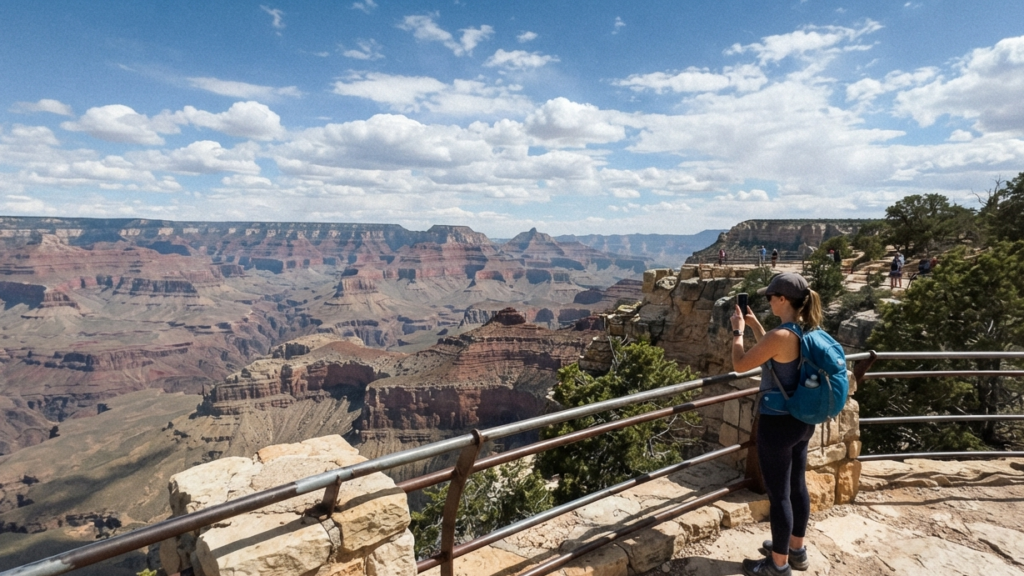
The South Rim can also be explored as a day trip when you pass by surrounding cities like Las Vegas or Flagstaff. Tourists use a personal car, bus, helicopters, or trains to get to the canyon. There are even more adventurous passengers who even do rim-to-rim hiking where they stay overnight a few nights.
A long weekend in the South Rim is the best option should you want to take a slower, relaxing tour. Although I am not suggesting to take a rim-to-rim trip, some of the smaller hikes within the National Park will allow you to get much closer to the canyon and the Colorado River.
You can visit the Grand Canyon in just a few hours in order to have a glimpse of it, but to really enjoy this natural marvel you must spend at least two days. I suggest after taking a few days in the park or nearby so that you can use your times visiting other viewpoints, riding the shuttle routes and spend a few day hikes.
Why is the Grand Canyon So Special?
The Grand Canyon belongs to the number of natural wonders of the world.
The distance across the desert terrain of the American Southwest an average of 287 river miles, with an approximate size of 10 miles deep and 18 miles wide. It is a wonderful landform that has been formed by the Colorado River and its lengthy and tedious process of erosion during millions of years.
Nevertheless, there is no figure that could train you on the emotion of being on the brink of the canyon. The view cannot be completely described by anything, the enormity, the silence, power.
A Living History of the Earth
Even though the Grand Canyon is not the deepest canyon in the world, it happens to be the one that made it into the list of the natural wonders of the world. The reason is that it is not simply a canyon, it is a living history of the earth.
As you proceed into the gorge, you find layers of rocks dating back to as few as a few million years old and as far back as almost a billion years old. Here some of the oldest formations are found in the rock formations in the North American continent. To geologists, the canyon is a book with each layer a testimony of the times when oceans existed, rivers flowed, and shields of granite shielded the earth.
The Colorado River and What Lies Beneath
You can peep over the canyon a good many miles down at the Colorado River. It has eroded sharp walls and dramatic falls in the terrain over millions of years. The further you get away out of the roar of human existence and enter the expanse of nature, the more effective and deep the canyon is.
Beneath the surface lie underground caves, karst formations, and volcanic features, as well as fossil records of ancient creatures, such as dragonflies and reptiles. No wonder, the canyon has been held in high esteem by the Navajo and other natives of the area.
Initial Perception About the Grand Canyon
The moment when you stand on the edge of the Grand Canyon can be overwhelming and humbling.
That was the way I felt.
I am a mere girl who enjoys watching the world. When I stepped on the rim the first time I knew nothing about geology, and watched the blue sky change to deep gold in the evening light. I experienced my own smallness in that moment compared to the size of time itself. Canyon made me think about my position in the universe, under the sky full of far away stars and unlimited galaxies.
I recall feeling the size of this immense canyon imprinted on the land of this giant canyon in Northwest Arizona. And I really do mean it when I say, nothing prepares you to the magnificence of the Grand Canyon.
I belong to the country of the Himalayas where deep gorges and old valleys are the landscape and culture. Nevertheless, the Grand Canyon is incomparable to anything.
First Morning at Mather Point
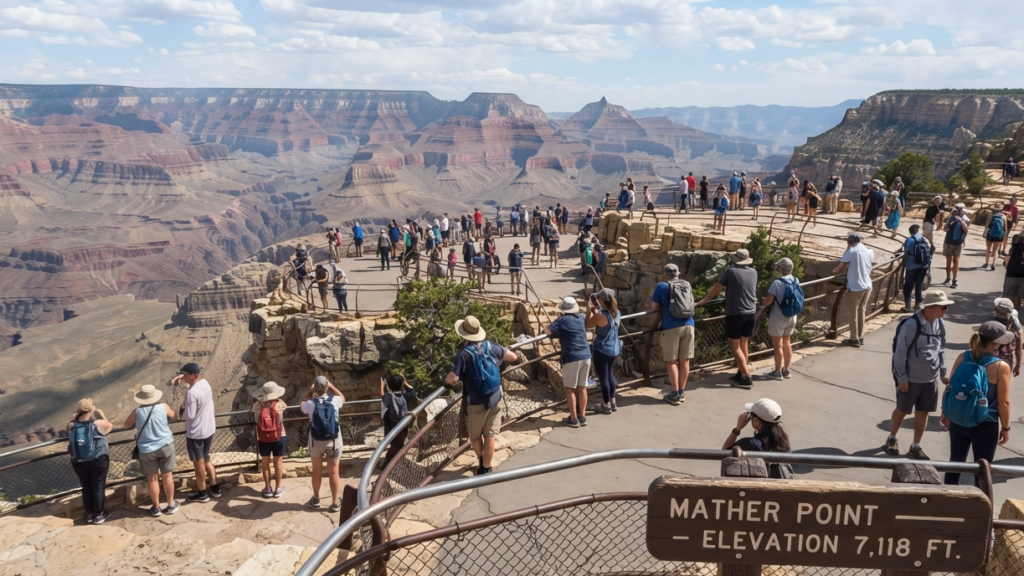
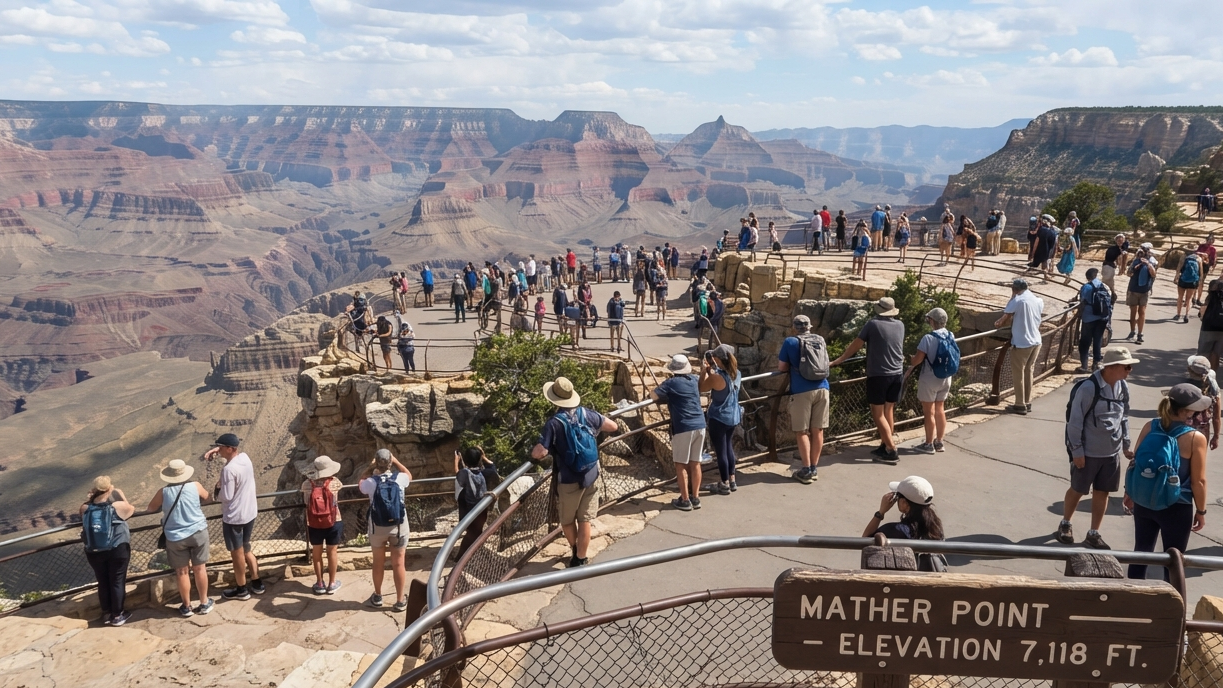
The South Rim starts at the Mather Point which is a scenic point nearest the Visitor Center. In the early morning I saw the horizon grow warm and pink with the sunlight lifting over the canyon. There was a fearsome slope that plunged downwards beneath the rim, and there a few photographers were already assembled. The region was friendly and in good condition, and there were facilities of visitors and infrastructure of interest to tourists.
Vishnu Schist: The Oldest Rocks in the Area
I did not overstate the words when I told you that I was inclined to go at least down to the lowest depths of the canyon, even nearer to the metamorphic quartz bottom wherein is to be found the Vishnu Schist, the oldest of the rocks of the area. To geologists, this is a treasure trove. Vishnu Schist was estimated to be approximately 1.8 billion years old which narrates the history of the Grand Canyon’s first and most dramatic formation.
Mather Point used to be a sea floor and also a mountain range. It is what is so beautiful about this place–not landscape, but history in action.
The Best View of the Grand Canyon: The South Rim
The South Rim attracts the highest number of visitors to the Grand Canyon.
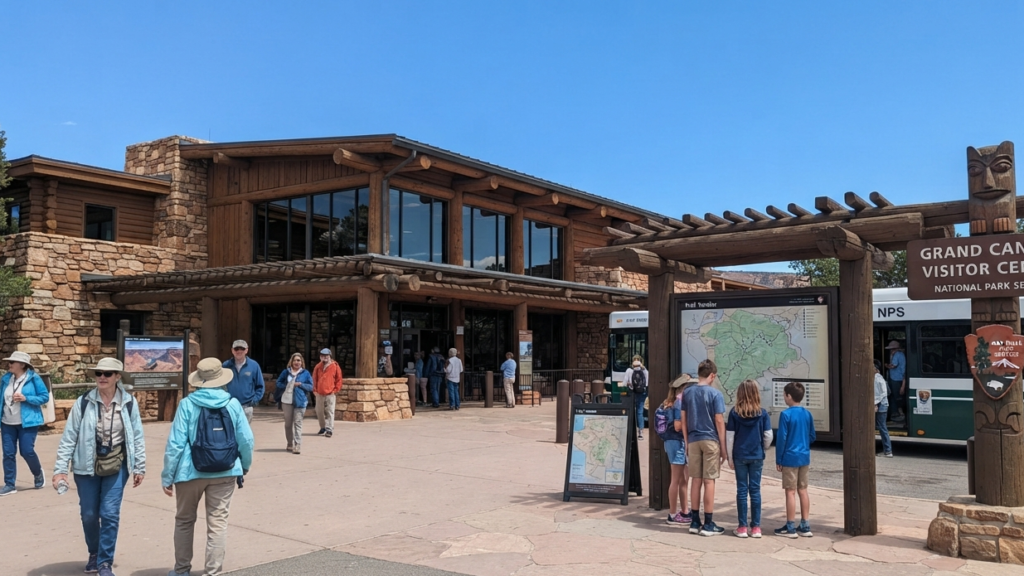
And you will encounter some of the finest views, dramatic cliff edges, Desert View, river views, wildlife, visitor centers, and easy access to short hikes. The South Rim has a number of lodges within the National Park making it the most ideal solution in case you would like to be near the canyon.
The South Rim offers another opportunity to explore the entire beauty of the canyon and you can do so by driving along a paved road to the East Entrance. On the South Rim you can look nearly as far across the country in a short distance as in any other quarter.
South Rim is also well-informed with regards to facilities such as bus services, numerous hiking paths, and various visitor centers. Better still, it is open all year round even in winter when the North Rim is closed.
North Rim of the Grand Canyon
The North Rim gets very few visitors as compared to the South Rim. It is missing the perspectives and infrastructure of the South, but can provide something new, and that is tranquility, openness, and more wilderness, according to some travelers.
It also sees wildlife sightings, which are the bison, cougars, and pink rattlesnakes. You can be fortunate enough to see the canyon as you approach it to the North.
The perspectives are less, and you have to drive a little further to get to them. Nevertheless, the North Rim provides stunning sunsets and a relaxing environment.
The distance between the North and South Rims is not long as it would seem by looking at the map but is nevertheless long. At some times they are merely 17 miles apart in a straight line, whereas by road the trip might take about five hours.
North Rim is not open in the spring, summer and fall. Weather is severe in winter, and most business ventures in and around the park close down during the season. From Salt Lake City, the North Rim is approximately a seven-hour drive.
Proximity of Major Cities to the North Rim of the Grand Canyon
- Jacob Lake to North Rim: 30 miles / 48 km / 1 hour.
- Page to the North Rim: 105 miles / 168 km / 3.5 hours
- Flagstaff to the North Rim: 207 miles / 333 km / 5 hours.
- Phoenix to the North Rim: 351 miles / 565 km / 7 hours
- Sedona to the North Rim: 236 miles / 380 km / 5.5 hours
- Las Vegas to the North Rim: 275 miles / 443 km / 5.5 hours
The West Rim of the Grand Canyon
Travellers looking to spend the day on a trip to Las Vegas prefer the West Rim. The colorful Seven Magic Mountains and Hoover Dam are some of the places that many tours will visit on their way.
It lacks scenery points as compared to the South Rim, but it is renowned because of the Grand Canyon Skywalk which is a bridge made of glass that runs over the canyon. The West Rim is not a part of the National Park and is a very different experience.
The Hualapai Tribe owns it privately and the guests can also have helicopter rides, ziplining and Colorado River rafting in this region. Remember that the mount on the West bed is fee charged independently of the National Park charges on the South and North Rims.
- Grand Canyon West to Las Vegas: 126 miles / 202 km / 2 hours.
- Through Kingman of other Arizona cities: 71 miles / 114 km / 1.5 hours.
Which Rim Should First-Timers Visit?
First-timers should definitely visit the South Rim. It has the richest adventure, featuring scenic routes, observations, and brief hikes. The North Rim might offer a more satisfying experience to you, with fewer crowds, though fewer activities.
The North and the South Rims cannot be visited in a single day. You would spend most of your time driving instead of actually enjoying the canyon. Exploring A better than starting B before A.
How We Planned a 2 Nights, 3 Days Grand Canyon Trip
At the start of July we flew into Phoenix after a trip to the East Coast. The journey itself took more than eight hours, with delays and airport errands.
On the first day, we stayed at a hotel close to the Airport of Phoenix and then hired a car with Hertz which we drove directly to Tusayan, a tiny village just 7 km away from the entrance gate of the South Rim.
We did so, however, making a delicious Greek stop in Flagstaff, playing country music on our road trip, driving up the legendary Route 66, and passing the train to the Grand Canyon before we even arrived in the small town of Tusayan. We lodged at Red Feather Lodge.
It was almost ghostly at night in Tusayan. It had a single Mexican restaurant and a couple of steak houses, and so we had dinner delivered by the Mexican restaurant.
Sunrise at Mather Point
We rose the following morning early in the morning at sunrise and drove to Mather Point so as to enjoy a beautiful sunrise. It was a moment to remember. All that had been touched by the light appeared part of the canyon.
This is crude, pure America the place where European settlers used to discover and transform it. It is the land where human ambition is great and minor.
Start Early: Shuttle Buses and Short Hikes
At Mather Point we went to Hermit Rest. A lot of blogs recommend driving, but by the time that the entry of personal vehicles was not permitted, we used a free shuttle bus within the park. Parking was free which helped.
I cannot stress this enough: start early. It is a nice morning, the heat is not oppressive, and the shuttle buses are far less crowded. By noon the crowd can get much larger, and the shuttle lines can be hundreds of people long, particularly during a holiday weekend, such as the Fourth of July.
It is also best to start early when you intend to do short hikes. It is hot during the summer at the Grand Canyon.
The Drive to Desert View and East Entrance
Noon came around later, as we drove into the East Entrance, or Desert View, on the way to Page, where we were going to spend the night and see the Antelope Canyon the following morning.
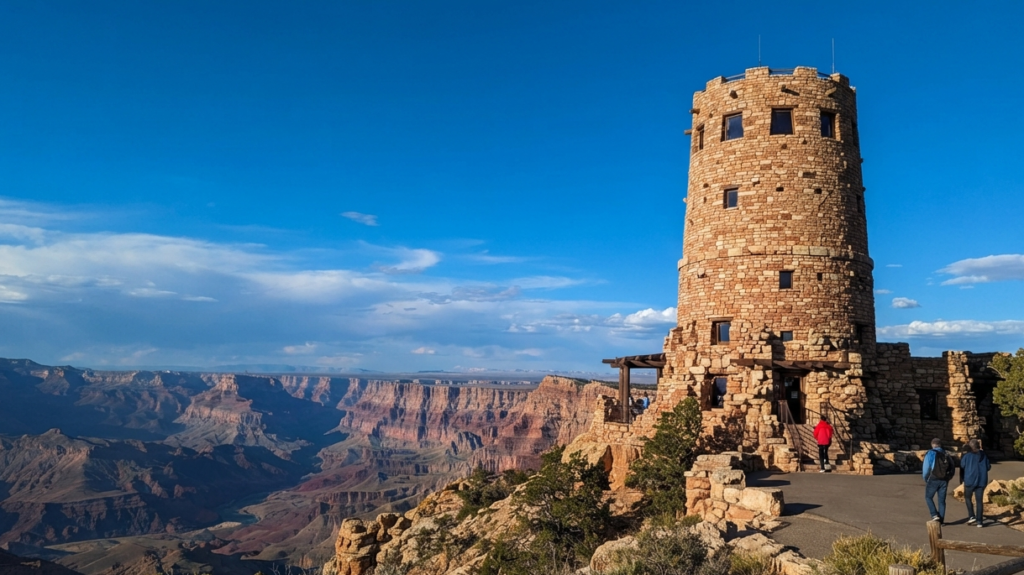
The road to the right of Mather Point, the purple route as it is popularly known, is a pleasure to ride. Trees, flying condors, rocky terrains, and trailers in the canyon make the journey itself memorable. The highway seems to be heading in the very depth of the history of the canyon.
We were at Desert View, practically on the East Entrance, in no time. I highly recommend this drive. It provides you with a full picture of the way the canyon formed in the course of 1.8 billion years. And above you can see the sheer sides of the canyon, and the smoother plains outside, above which the Colorado River is still making its long way.
The rocks are bright and unreal at sunset. We were able to see the Grand Canyon in various perspectives without undertaking any significant hikes in a single day. It was our first-time expedition in summer, and it is one that could be undertaken even during the winter months.
Out of the Grand Canyon, you can proceed to Zion, Bryce, Monument Valley, Sedona or Page. We booked two nights into Page.
Given an entire week, I would have made a classic Utah road trip.
Visiting the Grand Canyon: What City Should You Fly Into?
Official estimates say that more than 5 million people visit the Grand Canyon every year, but only a small number stay overnight near the park. The majority of visitors are on day trips with big cities, particularly Las Vegas. The canyon is also a destination of numerous people on a bigger road trip to the Southwest, which includes Utah and Arizona.
It is possible to fly to one of the big cities that are close to the Grand Canyon and then drive to the park. Other visitors go on a bus tour or the historic train or even down a helicopter.
Nevertheless, I can still suggest staying at least two days to get a more complete and significant experience. You will be left wanting to take another trip a day after day.
Nearest Airports and Drive Times
The nearest airport is in Flagstaff, although it has limited service. Las Vegas, Phoenix, and Flagstaff are the largest metropolitan areas nearest to the Grand Canyon.
- Las Vegas to the Grand Canyon: approximately 4 hours.
- Phoenix to the Grand Canyon: approximately 3.5 hours.
- Grand Canyon to Flagstaff: approximately 1.5 hours.
The North Rim is nearer in case you are visiting Nevada, Utah, or Salt Lake City. It is about seven hours via Salt Lake City, not considering traffic. The city is also able to reach Las Vegas through the global airport, thus it is easy to access Las Vegas by international travelers.
Hotels Around the South Rim
Whenever you are at the South Rim, you can either spend the night at Flagstaff or the smallest village that is near the park, which is Tusayan. Another small nearby town is Williams, circa 33 miles west of Flagstaff, and has very few hotels, which are fairly fast to fill in summer.
Another landmark that Williams is associated with that draws visitors to the South Rim is the vintage train that has been pulling passengers on a daily locomotive ride.
Driving to the Grand Canyon South Rim
Flagstaff
Compared to Tusayan or the park, Flagstaff is a vibrant town with a greater number of restaurants, cafes, bookstores, and nighttime activities. The negative side is that you will need to drive an hour or two to the canyon in the morning, and the park entrance is often very busy during busy seasons.
Tusayan
There are extremely few attractions in Tusayan other than the visitor center, a campground, a few restaurants, and barebones accommodations. But this is the simplest place to be where you wish to gain access to the South Rim early. It also is less expensive, as hotels are typically below USD 150/night. It is merely 7km between Tusayan and the entrance gate of the Grand Canyon.
Some hotel options include:
- 4 stars: Best Western Premiere Grand Canyon Squire Inn.
- 3-star: The Grand Hotel at the Grand Canyon, Grand Canyon Plaza Hotel, Holiday Inn Express
- 2-star: Red Feather Lodge
Hotels in Valle
The road to Valle runs 29 miles, approximately one-half an hour, to the South Rim.
- 3-star: Dumplin Patch Bed & Breakfast
- 2-star: Grand Canyon Inn and Motel
- Glamping: Under Canvas Grand Canyon
Lodging in Grand Canyon National Park
You can even camp in the park itself. A variety of options exists, starting with the historic cabins of El Tovar Lodge, and going down the line to the Yavapai Lodge, which is cheaper. Keep in mind that Yavapai Lodge does not have air conditioning.